
IN SUMMARY
Key takeaways
Key takeaways
AI can accelerate life cycle assessment, especially inventory research and background-data matching, but speed does not guarantee credibility. This guide explores expert-led, AI-assisted workflows, the importance of provenance and reproducibility, and why primary data and human review remain essential.
AI can now build a first-pass life cycle assessment (LCA) model in minutes. Whether that model is credible is a separate question.
The biggest gains are in inventory work: finding data, filling gaps and mapping to background databases.
Regulation and reporting carry the highest cost of error, so that is where expert judgment and an audit trail matter most.
Primary data from real supply chains becomes more valuable as AI makes plausible secondary data cheap.
AI can accelerate life cycle assessment, especially inventory research and background-data matching, but speed does not guarantee credibility. This guide explores expert-led, AI-assisted workflows, the importance of provenance and reproducibility, and why primary data and human review remain essential.
AI can now build a first-pass life cycle assessment (LCA) model in minutes. Whether that model is credible is a separate question.
The biggest gains are in inventory work: finding data, filling gaps and mapping to background databases.
Regulation and reporting carry the highest cost of error, so that is where expert judgment and an audit trail matter most.
Primary data from real supply chains becomes more valuable as AI makes plausible secondary data cheap.
AI can accelerate life cycle assessment, especially inventory research and background-data matching, but speed does not guarantee credibility. This guide explores expert-led, AI-assisted workflows, the importance of provenance and reproducibility, and why primary data and human review remain essential.
AI can now build a first-pass life cycle assessment (LCA) model in minutes. Whether that model is credible is a separate question.
The biggest gains are in inventory work: finding data, filling gaps and mapping to background databases.
Regulation and reporting carry the highest cost of error, so that is where expert judgment and an audit trail matter most.
Primary data from real supply chains becomes more valuable as AI makes plausible secondary data cheap.
What is AI in life cycle assessment?
AI in life cycle assessment means using machine learning and language models to speed up parts of the LCA workflow, such as researching literature, drafting inventories, matching data to background databases and checking data quality. The best implementations keep an expert practitioner in control and record where every number came from.
Why AI and LCA are colliding now
Five years ago, an LCA was typically a one-off report on a single product. Today companies are asked to assess whole product portfolios, across complex supply chains, with supplier data and fast turnaround. A first-pass result in a couple of weeks is now a realistic expectation, even for something as complex as a vehicle.
Regulation is driving the demand. Digital product passports are already under way in the battery sector, and the EU’s ESPR could extend them across many product groups. Companies are also under pressure to use primary data and to report on scope 3.
There are not enough LCA practitioners to meet that demand by hand. That is why AI will be deployed at scale. The open question is whether we are ready for what that means.
The credibility gap
The effort and time needed to produce an LCA output have never been lower. Our ability to check the quality of that output has not kept pace.
Traditional safeguards, such as data quality indicators, were built for human-made models. AI-generated work can look compelling while being wrong, and it can present weaker results with the same confidence as strong ones. We call this the credibility gap.
Where AI fits in the LCA workflow
AI can touch almost every phase of an LCA, but the opportunity and the risk differ by phase.
LCA phase | AI opportunity | Our view |
|---|---|---|
Goal and scope | Support with system boundaries and functional units | The practitioner should keep control of direction |
Inventory analysis | Find data, fill gaps, draft unit processes | The biggest and most mature opportunity |
Impact assessment | Go beyond narrow regulatory impact categories | Under-explored |
Interpretation | Data quality scoring, uncertainty, hotspot analysis | A rich vein, and often skipped in published studies |
Inventory is where the time goes. Finding the right electricity figure for one process can mean searching the literature or chasing a supplier who may need to ask a colleague. Finding a suitable proxy dataset used to take hours. AI cuts that bottleneck sharply.
Interpretation is the quiet opportunity. Many published studies lack data quality indicators and uncertainty analysis because they are hard to do well. Automating them would help, even if the first pass is imperfect. A rough data quality score is better than none.
AI in life cycle assessment means using machine learning and language models to speed up parts of the LCA workflow, such as researching literature, drafting inventories, matching data to background databases and checking data quality. The best implementations keep an expert practitioner in control and record where every number came from.
Why AI and LCA are colliding now
Five years ago, an LCA was typically a one-off report on a single product. Today companies are asked to assess whole product portfolios, across complex supply chains, with supplier data and fast turnaround. A first-pass result in a couple of weeks is now a realistic expectation, even for something as complex as a vehicle.
Regulation is driving the demand. Digital product passports are already under way in the battery sector, and the EU’s ESPR could extend them across many product groups. Companies are also under pressure to use primary data and to report on scope 3.
There are not enough LCA practitioners to meet that demand by hand. That is why AI will be deployed at scale. The open question is whether we are ready for what that means.
The credibility gap
The effort and time needed to produce an LCA output have never been lower. Our ability to check the quality of that output has not kept pace.
Traditional safeguards, such as data quality indicators, were built for human-made models. AI-generated work can look compelling while being wrong, and it can present weaker results with the same confidence as strong ones. We call this the credibility gap.
Where AI fits in the LCA workflow
AI can touch almost every phase of an LCA, but the opportunity and the risk differ by phase.
LCA phase | AI opportunity | Our view |
|---|---|---|
Goal and scope | Support with system boundaries and functional units | The practitioner should keep control of direction |
Inventory analysis | Find data, fill gaps, draft unit processes | The biggest and most mature opportunity |
Impact assessment | Go beyond narrow regulatory impact categories | Under-explored |
Interpretation | Data quality scoring, uncertainty, hotspot analysis | A rich vein, and often skipped in published studies |
Inventory is where the time goes. Finding the right electricity figure for one process can mean searching the literature or chasing a supplier who may need to ask a colleague. Finding a suitable proxy dataset used to take hours. AI cuts that bottleneck sharply.
Interpretation is the quiet opportunity. Many published studies lack data quality indicators and uncertainty analysis because they are hard to do well. Automating them would help, even if the first pass is imperfect. A rough data quality score is better than none.
Two models: AI builds, or AI assists
There are two philosophies for AI in LCA.
AI builds the model, the practitioner reviews. The AI researches, defines the system boundary and drafts the inventory. The practitioner becomes an editor. This is fast, but it is a black box: you don’t control or fully see its decisions.
The practitioner leads, AI assists. The practitioner runs the LCA as they would normally, and AI supports the slow, repetitive steps. Every suggestion is ranked, explained and approved by a person.
At Minviro, we favour the second model. For work that supports regulation, reporting or large investment decisions, we think expert-led, AI-assisted LCA is the right approach.

What a live demo showed us
In the talk, we asked the audience for a product to model and got “a carbon fibre composite part”. With one broad prompt, a prototype research tool did the desk research, chose unit processes (precursor, fibre, resin and part manufacturing), drafted an inventory and referenced its sources. It also flagged values it had calculated when it couldn’t find a literature figure.
That would have taken months of research not long ago. Three lessons came out of it.
Specificity matters. A broad prompt lets the AI choose the production route, region and technology. It may blend studies from different technologies, which produces a meaningless result. Nickel sulphate, for example, can be made through several processes.
Results are not reproducible by default. Running the same prompt several times can give different unit processes, references and system boundaries. Narrower prompts reduce the variation, but if more than one study exists, the AI still has choices to make.
It can hallucinate. In a follow-up check, one modelled flow had a value with no explanation of how it was calculated. The tool is usually transparent about this, but not always, and that is exactly the risk.
The output also still needs mapping to background datasets. That is where AI assistance inside the software helps.
There are two philosophies for AI in LCA.
AI builds the model, the practitioner reviews. The AI researches, defines the system boundary and drafts the inventory. The practitioner becomes an editor. This is fast, but it is a black box: you don’t control or fully see its decisions.
The practitioner leads, AI assists. The practitioner runs the LCA as they would normally, and AI supports the slow, repetitive steps. Every suggestion is ranked, explained and approved by a person.
At Minviro, we favour the second model. For work that supports regulation, reporting or large investment decisions, we think expert-led, AI-assisted LCA is the right approach.

What a live demo showed us
In the talk, we asked the audience for a product to model and got “a carbon fibre composite part”. With one broad prompt, a prototype research tool did the desk research, chose unit processes (precursor, fibre, resin and part manufacturing), drafted an inventory and referenced its sources. It also flagged values it had calculated when it couldn’t find a literature figure.
That would have taken months of research not long ago. Three lessons came out of it.
Specificity matters. A broad prompt lets the AI choose the production route, region and technology. It may blend studies from different technologies, which produces a meaningless result. Nickel sulphate, for example, can be made through several processes.
Results are not reproducible by default. Running the same prompt several times can give different unit processes, references and system boundaries. Narrower prompts reduce the variation, but if more than one study exists, the AI still has choices to make.
It can hallucinate. In a follow-up check, one modelled flow had a value with no explanation of how it was calculated. The tool is usually transparent about this, but not always, and that is exactly the risk.
The output also still needs mapping to background datasets. That is where AI assistance inside the software helps.
Four things AI-assisted LCA must get right
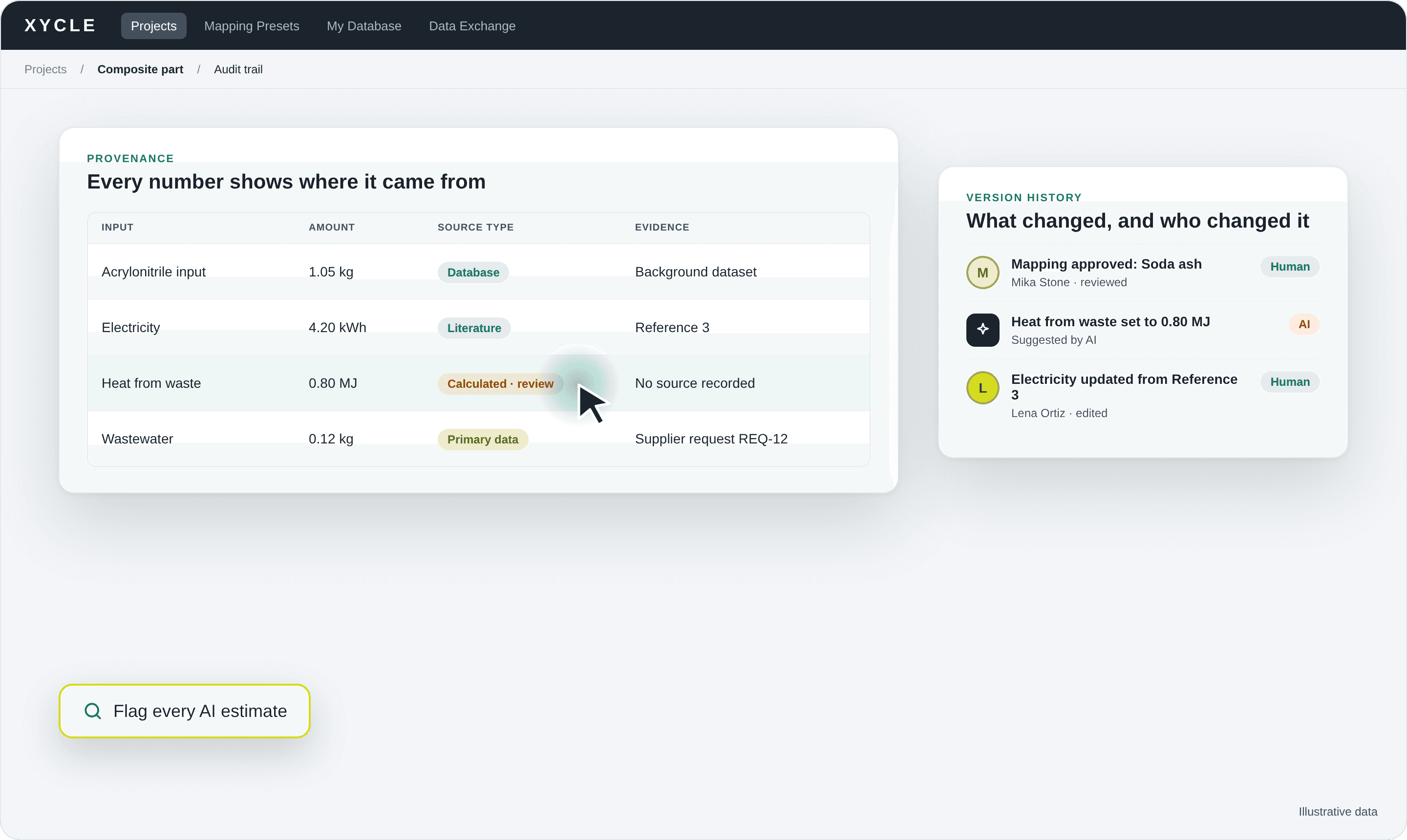
Absolute provenance. If you don’t know where a number came from, nobody can review it.
Transparent gap filling. Estimates and calculated values must be visibly flagged.
Explicit methodological choices. For example, how co-products are allocated or whether system expansion is used.
Reproducibility. This is the hardest one with AI, and a good reason to be specific and to keep a human in the loop.
Version history matters just as much. When AI and people both change a model, you need to see what changed and who changed it.

Match the rigour to the risk
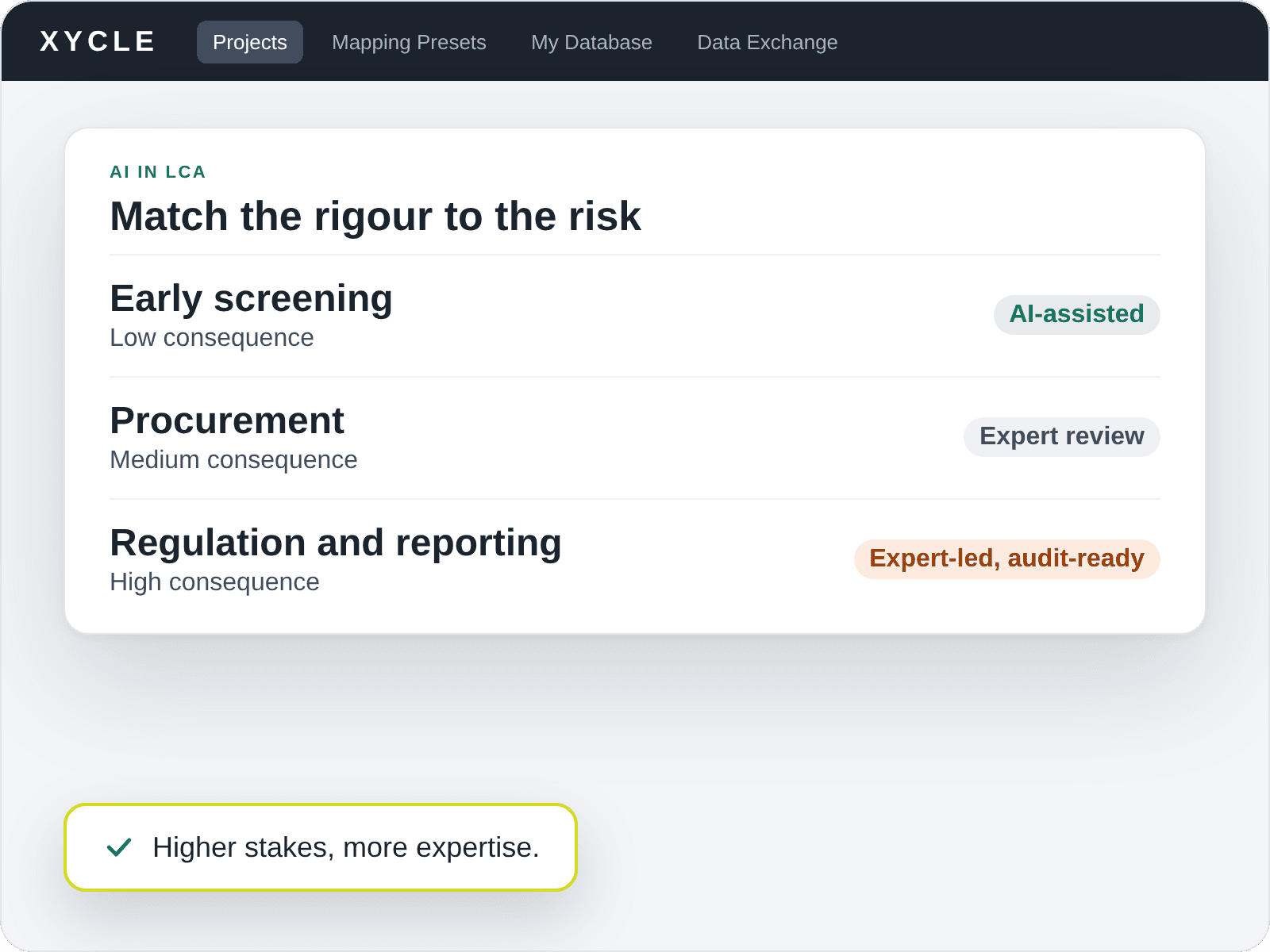
Not every LCA carries the same consequences if it is wrong.
Early screening and eco-design: low consequence. AI can show teams hotspots they never knew about, such as a chemical with a large hidden impact, even if the quality isn’t perfect.
Procurement and internal decisions: medium consequence. Errors can cost money but are unlikely to sink the business.
Regulation and reporting: high consequence. A shortcut that nobody can explain, behind an environmental claim nobody can substantiate, can cost a company dearly in penalties and reputation.
Standards, certification and audit practices will need to evolve if AI is used in studies like these.

What practitioners will do less of, and more of
Less: manual data entry, searching through databases for the right dataset, building boilerplate models from scratch, writing very long reports and running routine scenario checks.
More: framing the core question, making methodological calls, reviewing AI output critically, securing primary data from suppliers, communicating nuance rather than a single flat number, and running assessments at portfolio scale.
One shift we already see in commercial projects is the starting-point model. A bespoke model that used to take a long time can be built quickly, so effort goes into the hotspots and into getting primary data for those stages.
Why primary data becomes more valuable
AI can generate large volumes of plausible secondary data instantly. That makes primary data, collected directly from real supply chains and traceable to its source, more valuable, not less. It is also harder for a reviewer to challenge.
The verifier’s view
A question from a verifier in the session is worth repeating: what stops someone asking an AI for the lowest plausible data? The risk exists, though it exists with human practitioners too. Checking becomes harder when a model draws on data from many points in the supply chain.
There is a positive side. Lower modelling cost makes independent benchmarking easier, and AI could also help verification itself, for example by placing a supplier’s primary data against a distribution of expected values.
Absolute provenance. If you don’t know where a number came from, nobody can review it.
Transparent gap filling. Estimates and calculated values must be visibly flagged.
Explicit methodological choices. For example, how co-products are allocated or whether system expansion is used.
Reproducibility. This is the hardest one with AI, and a good reason to be specific and to keep a human in the loop.
Version history matters just as much. When AI and people both change a model, you need to see what changed and who changed it.

Match the rigour to the risk
Not every LCA carries the same consequences if it is wrong.
Early screening and eco-design: low consequence. AI can show teams hotspots they never knew about, such as a chemical with a large hidden impact, even if the quality isn’t perfect.
Procurement and internal decisions: medium consequence. Errors can cost money but are unlikely to sink the business.
Regulation and reporting: high consequence. A shortcut that nobody can explain, behind an environmental claim nobody can substantiate, can cost a company dearly in penalties and reputation.
Standards, certification and audit practices will need to evolve if AI is used in studies like these.

What practitioners will do less of, and more of
Less: manual data entry, searching through databases for the right dataset, building boilerplate models from scratch, writing very long reports and running routine scenario checks.
More: framing the core question, making methodological calls, reviewing AI output critically, securing primary data from suppliers, communicating nuance rather than a single flat number, and running assessments at portfolio scale.
One shift we already see in commercial projects is the starting-point model. A bespoke model that used to take a long time can be built quickly, so effort goes into the hotspots and into getting primary data for those stages.
Why primary data becomes more valuable
AI can generate large volumes of plausible secondary data instantly. That makes primary data, collected directly from real supply chains and traceable to its source, more valuable, not less. It is also harder for a reviewer to challenge.
The verifier’s view
A question from a verifier in the session is worth repeating: what stops someone asking an AI for the lowest plausible data? The risk exists, though it exists with human practitioners too. Checking becomes harder when a model draws on data from many points in the supply chain.
There is a positive side. Lower modelling cost makes independent benchmarking easier, and AI could also help verification itself, for example by placing a supplier’s primary data against a distribution of expected values.
How Minviro approaches AI in LCA
Our philosophy is that the LCA practitioner is critical to quality, so we build AI-assisted workflows, not black boxes. In XYCLE, AI suggests background-data matches from your databases, with a match rating, and the practitioner reads the metadata and approves or rejects each one. Version history and an audit trail show what changed.
[CONFIRM current XYCLE AI features with Andy before publishing.]
Frequently asked questions
Why do AI-generated LCAs differ from run to run?
Broad prompts leave the AI free to choose technologies, regions and references. More specific prompts reduce the variation but may not remove it.
Will AI replace LCA practitioners?
We don’t think so. The work shifts from data entry to judgement, review, supplier engagement and communicating nuance.
Watch the talk
Hear the full session, including the live demo and audience questions: Watch on YouTube →. To see AI-assisted LCA in XYCLE, start a free trial → or talk to an expert →.
Our philosophy is that the LCA practitioner is critical to quality, so we build AI-assisted workflows, not black boxes. In XYCLE, AI suggests background-data matches from your databases, with a match rating, and the practitioner reads the metadata and approves or rejects each one. Version history and an audit trail show what changed.
[CONFIRM current XYCLE AI features with Andy before publishing.]
Frequently asked questions
Why do AI-generated LCAs differ from run to run?
Broad prompts leave the AI free to choose technologies, regions and references. More specific prompts reduce the variation but may not remove it.
Will AI replace LCA practitioners?
We don’t think so. The work shifts from data entry to judgement, review, supplier engagement and communicating nuance.
Watch the talk
Hear the full session, including the live demo and audience questions: Watch on YouTube →. To see AI-assisted LCA in XYCLE, start a free trial → or talk to an expert →.


