
At a glance
Working with ORE Limited, an early-stage climate venture focused on food supply chain decarbonisation, Minviro set out to find where emissions actually sit across a food value chain, and where intervention does real work. The collaboration modelled the full cradle-to-fork lifecycle of a food product using XYCLE, applying Energy Loss Mapping alongside standard LCA to pinpoint hotspots from cattle feed through to cold chain refrigeration. The result was a prioritised, evidence-based decarbonisation roadmap built on primary data rather than sector averages.
Working with ORE Limited, an early-stage climate venture focused on food supply chain decarbonisation, Minviro set out to find where emissions actually sit across a food value chain, and where intervention does real work. The collaboration modelled the full cradle-to-fork lifecycle of a food product using XYCLE, applying Energy Loss Mapping alongside standard LCA to pinpoint hotspots from cattle feed through to cold chain refrigeration. The result was a prioritised, evidence-based decarbonisation roadmap built on primary data rather than sector averages.
Key Challenge
The food system is responsible for roughly one-third of global greenhouse gas emissions. That figure gets quoted often. What gets discussed far less is where those emissions concentrate, and why the standard ways of measuring them tend to miss the mark. Over 90% of industrial heat used in food production still comes from fossil fuels, but the harder problem is structural: fragmented supplier data, variable farming practices, and limited traceability make accurate carbon accounting difficult across most food value chains. The question Minviro and ORE set out to answer together was a direct one: where are the real hotspots, and where does intervention actually move the needle?
Solution
The collaboration modelled the full lifecycle of a food product using XYCLE, mapping every energy input, ingredient, and logistics stage from farm to fork across Scope 1, 2, and 3 emissions. The scope ran from primary production and farming through regional distribution, transport to retail, and food service and domestic preparation. Beyond standard LCA, the work applied Energy Loss Mapping: tracing not only what energy is consumed at each stage, but where it leaks before it reaches the product. A typical pizza oven transfers only about 10% of its fuel energy into the pizza. The rest is lost to the room. Once you know where that energy goes, and whether it can be recovered, the decarbonisation problem looks different.
Results
The model identified cattle feed formulation as the dominant hotspot in animal-based ingredients, with compound pig feed alone accounting for 59.54% of salame's total impact per kilogram of live weight. Refrigeration was found to account for up to 80% of total energy use for some food manufacturers, with a further 20% of that energy lost purely to friction and equipment protection. These findings produced a prioritised set of interventions covering feed formulation, low-GWP refrigerants, green energy transition, and the 24,700 tonnes of food waste identified across the system.

Energy Loss Mapping showed that a typical pizza oven transfers only around 10% of its fuel energy into the product, exposing recoverable heat that reduces how much energy needs generating in the first place.
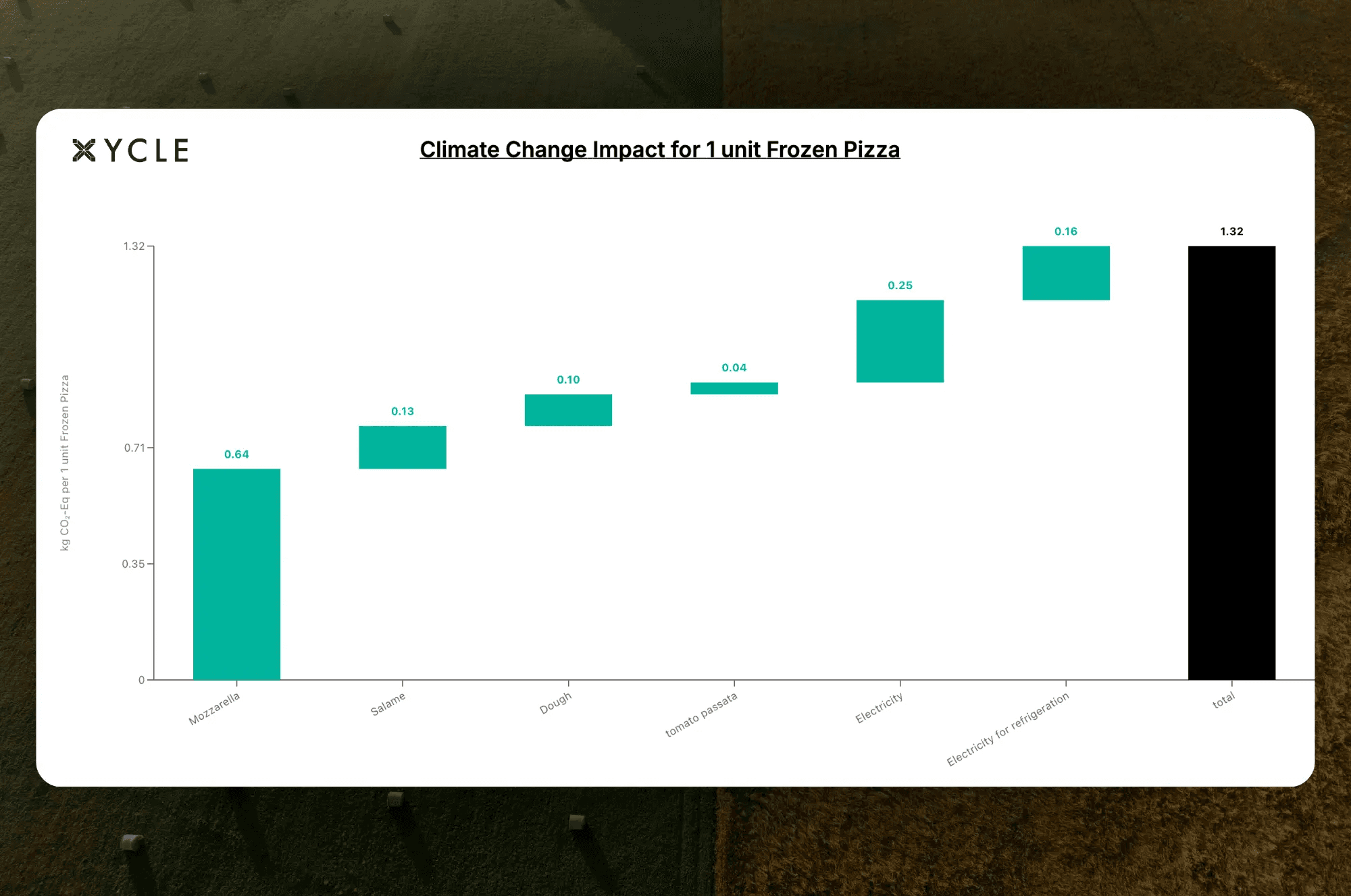
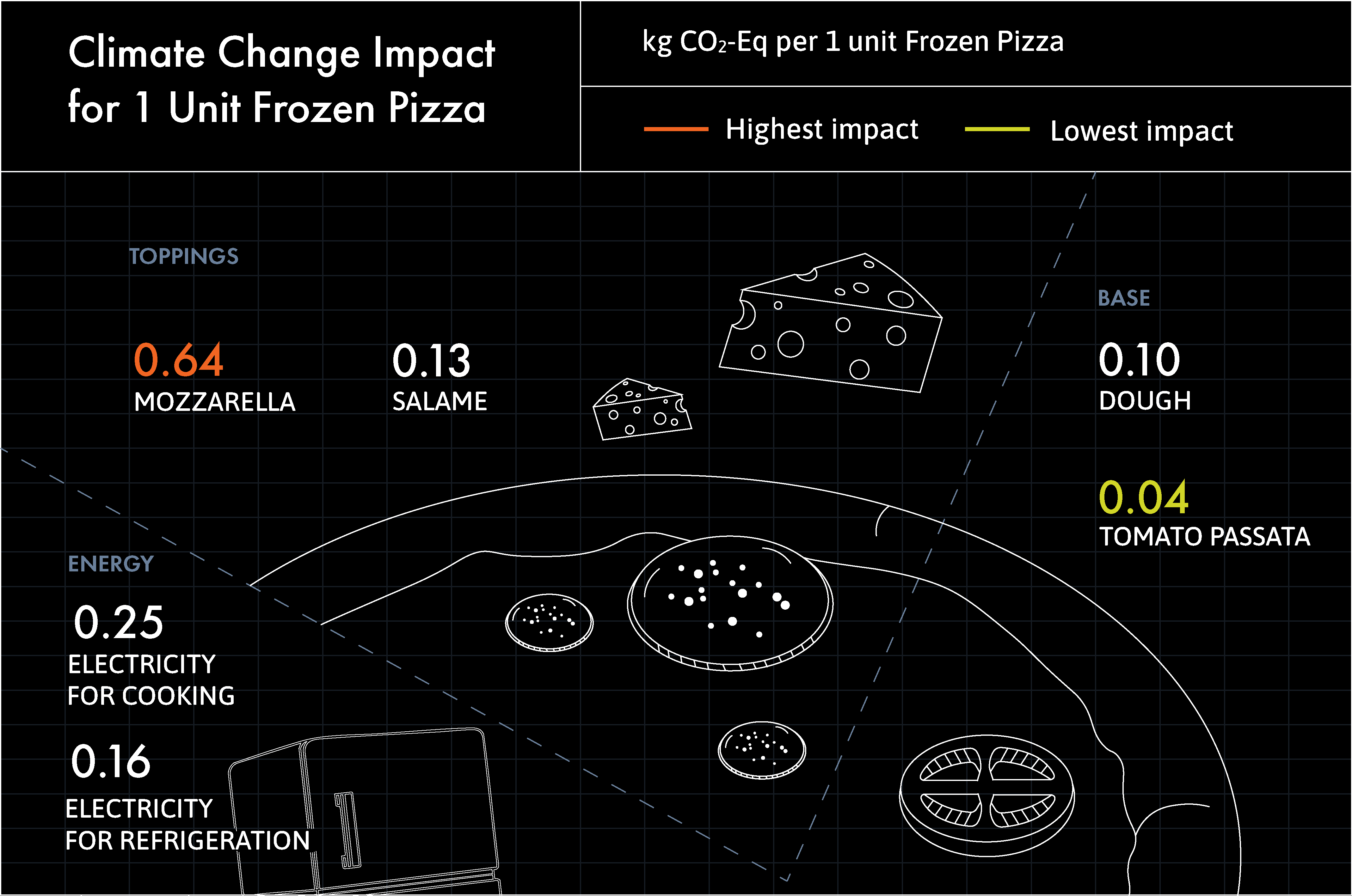
Mozzarella and salame emerged as the dominant carbon hotspots, with compound pig feed accounting for 59.54% of salame's impact, pointing intervention directly at feed formulation rather than logistics.
The analysis produced a quantified, stage-by-stage emissions inventory suitable for investor reporting, supplier engagement, and science-based target setting, built on primary data rather than sector averages.
Our collaboration
Our Resources Emissions (ORE) Limited is an early-stage climate venture focused on reducing greenhouse gas emissions across food supply chains and transport. Led by founder Dr Aminu Owonikoko, whose research background is in renewable energy from biomass and agri-food waste, ORE develops science-led solutions that combine alternative biofuels with lifecycle-based approaches to deliver practical decarbonisation outcomes. Minviro brought its LCA platform, XYCLE, to turn detailed lifecycle data into clear, actionable insights, enabling credible emissions hotspot analysis and decarbonisation planning across Scope 1, 2, and 3 emissions.
Tackling emissions uncertainty in the food supply chain
The food system is responsible for roughly one-third of global greenhouse gas emissions, yet the sector is uniquely complex. Emissions come from millions of small and large producers, each with distinct practices, energy sources, and supply networks. Over 90% of industrial heat used in food production still relies on fossil fuels, making decarbonisation technically and economically demanding. The challenge isn't only technological, it's systemic: fragmented data, variable farming methods, and limited traceability make accurate accounting extremely difficult.
The food system's transformation gaps
Despite growing momentum toward net-zero goals, deep decarbonisation in the food sector remains hindered by several structural gaps in performance, infrastructure, sustainability, regulation, and market alignment. Each represents both a challenge and an opportunity for collaborative innovation.
The performance gap reflects that many food producers still operate with outdated processes and limited visibility on energy efficiency and emissions intensity; integrating lifecycle data and digital tracking tools can expose inefficiencies and drive measurable performance gains. The infrastructure gap exists because cold chains, logistics networks, and food processing facilities often rely on legacy systems, which opens new markets for low-carbon design and construction, enabling both emissions reduction and resilience building. The sustainability gap arises where localised supply chains in emerging markets lack access to robust sustainability frameworks; by building local growth teams and partnerships, like the ORE-Minviro collaboration, data-driven capacity can be developed regionally. The regulatory gap comes from inconsistent carbon accounting rules and fragmented reporting standards that make compliance costly, where shared data infrastructure and cross-sector collaboration can help reduce these barriers while improving data quality and comparability. The preferences gap remains because consumer awareness is shifting, but sustainable choices remain underdeveloped in key markets; aligning data-driven transparency with local preferences can unlock growth and ensure equitable participation in the green transition.
Together, these gaps define the transformation agenda for the food system, one that requires synergy between technological innovation, lifecycle intelligence, and partnerships to convert fragmentation into coordinated climate action.
Lifecycle thinking in the food supply chain
A key insight emerging from new food industry research is that emissions data accuracy improves through supplier collaboration, not estimation alone. Lifecycle-based methods (LCA) make it possible to trace emissions back to each stage of production, identifying specific hotspots and inefficiencies. Engaging suppliers enables co-creation of emissions data, where producers input actual energy use, feed types, and transport patterns rather than generic averages. This dual approach, lifecycle modelling plus supplier engagement, builds a foundation for credible decarbonisation strategies and science-based targets.
The role of technology: from measurement to meaningful reduction
Reducing emissions across the food value chain requires more than incremental efficiency. It demands a complete understanding of where and how energy and materials are used. Technology enables this by capturing data at every link in the chain and transforming it into actionable insights for decarbonisation.
At primary production, from farm to regional distribution centre, this means monitoring oil, gas, and electricity use across farming and early-stage processing. Lifecycle data helps track refrigerant losses, energy for irrigation and lighting, and on-farm fuel consumption, while digital sensors and emissions-tracking platforms can identify hotspots in real time, informing targeted interventions such as electrified machinery, renewable heat, and regenerative practices. Across distribution and retail, between regional distribution centres and retail, digital twins and emissions dashboards quantify fuel use, refrigeration energy, and equipment-related losses, with optimisation algorithms supporting route planning and refrigeration efficiency to reduce both operational costs and embodied carbon. In transport to home, consumer logistics are a hidden but important emissions source, where data from mobility tracking and delivery models can quantify the carbon intensity of food transport from store to home, enabling low-emission delivery strategies and consumer awareness campaigns. In food service and domestic use, IoT-enabled kitchen systems and smart metering reveal energy intensity in commercial and household cooking, cooling, and reheating, supporting targeted technology adoption such as induction cooking and efficient cooling, alongside the design of low-carbon menus and appliances.
Investigative approach
The investigative framework follows the entire food journey, from farm to fork and beyond, linking sectoral emissions data to lifecycle impact categories. Using LCA-based digital platforms like Minviro's XYCLE, the team mapped every energy input, refrigerant, and fuel source to create a live emissions inventory, then went a step further with Energy Loss Mapping.
To put it in perspective: in the food industry, a typical pizza oven only transfers about 10% of its fuel energy into the pizza itself, the rest is simply lost to the room. The goal is to close that loop. By pinpointing exactly where energy is being lost, the most important question for clients can be answered: "Where can we put this wasted heat to work?" Recovering this energy means less needs to be generated in the first place, benefiting both the planet and the bottom line.
This approach allows stakeholders to identify sector-specific hotspots and apply Energy Loss Mapping to quantify the wasted heat, such as methane from livestock or energy losses in cold chains. It also lets them model scenarios for substitution, such as replacing fossil-based refrigeration with low-GWP refrigerants, and benchmark and track progress toward net-zero targets using standardised, comparable data.
Key impact summary
The work delivered impact across several dimensions. On climate mitigation, data visibility drives emission reductions across production, logistics, and consumption, and prioritising low-GWP refrigerants and energy-efficient technologies can significantly lower Scope 1-3 emissions. On digital innovation, emissions-tracking technology enables real-time decision-making and supply chain collaboration, transforming data into a sustainability management tool. Through circular economy integration, lifecycle visibility promotes system redesign, enabling reuse, recycling, and resource recovery across packaging and equipment. For equitable growth, technological modernisation of cold chains in emerging markets supports food security while embedding sustainability principles. On policy and research influence, standardised emissions data provides the evidence base for regulation, certification, and investment aligned with deep decarbonisation pathways. And in entrepreneurial leadership, founding ventures such as ORE Limited and Minviro drive climate tech innovation, building scalable solutions with commercial and environmental value.
Slicing into sustainability: A pizza LCA case study
To bring the complex world of agricultural LCAs to life, the team modelled the environmental impact of something everyone loves: pizza. This case study tracks the journey of pizza, from the farm to your plate, providing a tangible look at how every ingredient, the wheat for the dough, the tomatoes for the sauce, the milk for the cheese, and various toppings, contributes to the product's overall environmental footprint.
The research highlights the Food-Energy-Water Nexus, a complex web of interactions where each system depends on the others. For example, energy is required to treat water used in food processing, while water is essential for all food production. Both are critical inputs for every slice of pizza produced and consumed in the UK and globally. The analysis identified a significant environmental hotspot within the production chain of mozzarella, specifically concentrated in the rearing of the cattle.
Hotspots and ingredient contributions
The analysis identified significant environmental hotspots within the production chain, particularly in animal-based ingredients.
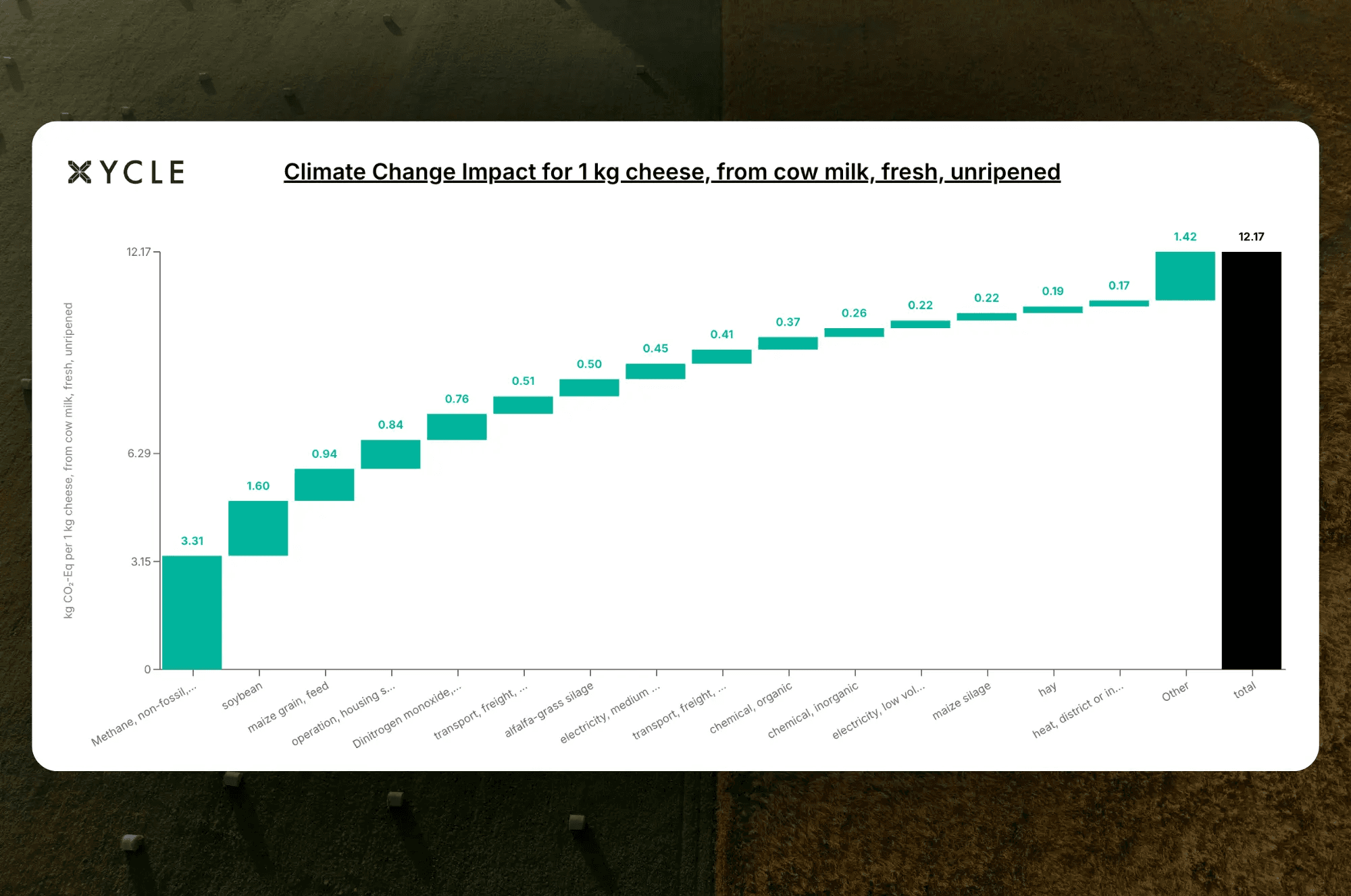
The most significant hotspots are concentrated in the rearing of livestock, where mozzarella and salame carry the animal impact. For salame production, compound pig feed contributes 59.54% (1.28 kgCO₂e) of the impact for 1 kg of live weight pig, and for mozzarella, the cultivation and processing of cattle feed are major contributors. Methane emissions add to this: enteric fermentation, cows and sheep "burping" methane, remains a potent greenhouse gas source. Mitigation involves changing feed formulations, such as experimenting with seaweed to reduce methane, or switching species.
Beyond the farm, energy, cooling, and logistics carry their own weight. The pizza flow chart shows that cooking and refrigeration are rooted deeply in energy sources. Keeping ingredients cold is energy-intensive; for some food manufacturers, refrigeration accounts for up to 80% of total energy use. Research also indicates that 20% of energy in the food industry is lost just to reduce friction and protect bearings from water ingress. Solutions include switching to low-GWP (Global Warming Potential) refrigerants like R-290 (propane) or cleaned CO₂, alongside strict leak detection to prevent the release of greenhouse gases. For logistics, the adoption of solar-powered refrigeration vehicles offers a path to cleaner transport, and transitioning to green energy tariffs is a vital step in reducing the Scope 2 emissions associated with this energy use.
Waste is a significant, yet often overlooked, contributor to a product's footprint. Nearly 24,700 tonnes of food waste significantly inflated total energy consumption. The LCA also highlights impacts beyond climate change, specifically air quality. The use of diesel vehicles and farm machinery emits particulates and nitrogen oxides (NOx), which pollute the air and directly impact public health.
Looking ahead
The decarbonisation of food supply chains depends on one thing above all: supply chain transparency. We cannot manage what we do not measure. From the methane emitted on the farm to the refrigeration requirements, every data point reveals a new opportunity for intervention. By combining data intelligence, supplier collaboration, and technological innovation, the food industry can turn complexity into coordinated climate action.
The path toward deep decarbonisation involves innovating at the source by transitioning to low-emission feed and optimised livestock systems; powering the process by moving to green energy to eliminate Scope 2 emissions; refining the cold chain by switching to low-GWP refrigerants and renewables-powered logistics to tackle the energy-heavy refrigeration sector; and eliminating waste by reducing the tonnage of food waste to significantly lower the energy demand of the entire group.
The journey from a carbon-intensive slice to a net-zero pizza is complex, but by uncovering these hotspots, we are building the pathways necessary for a sustainable food future.
Our Resources Emissions (ORE) Limited is an early-stage climate venture focused on reducing greenhouse gas emissions across food supply chains and transport. Led by founder Dr Aminu Owonikoko, whose research background is in renewable energy from biomass and agri-food waste, ORE develops science-led solutions that combine alternative biofuels with lifecycle-based approaches to deliver practical decarbonisation outcomes. Minviro brought its LCA platform, XYCLE, to turn detailed lifecycle data into clear, actionable insights, enabling credible emissions hotspot analysis and decarbonisation planning across Scope 1, 2, and 3 emissions.
Tackling emissions uncertainty in the food supply chain
The food system is responsible for roughly one-third of global greenhouse gas emissions, yet the sector is uniquely complex. Emissions come from millions of small and large producers, each with distinct practices, energy sources, and supply networks. Over 90% of industrial heat used in food production still relies on fossil fuels, making decarbonisation technically and economically demanding. The challenge isn't only technological, it's systemic: fragmented data, variable farming methods, and limited traceability make accurate accounting extremely difficult.
The food system's transformation gaps
Despite growing momentum toward net-zero goals, deep decarbonisation in the food sector remains hindered by several structural gaps in performance, infrastructure, sustainability, regulation, and market alignment. Each represents both a challenge and an opportunity for collaborative innovation.
The performance gap reflects that many food producers still operate with outdated processes and limited visibility on energy efficiency and emissions intensity; integrating lifecycle data and digital tracking tools can expose inefficiencies and drive measurable performance gains. The infrastructure gap exists because cold chains, logistics networks, and food processing facilities often rely on legacy systems, which opens new markets for low-carbon design and construction, enabling both emissions reduction and resilience building. The sustainability gap arises where localised supply chains in emerging markets lack access to robust sustainability frameworks; by building local growth teams and partnerships, like the ORE-Minviro collaboration, data-driven capacity can be developed regionally. The regulatory gap comes from inconsistent carbon accounting rules and fragmented reporting standards that make compliance costly, where shared data infrastructure and cross-sector collaboration can help reduce these barriers while improving data quality and comparability. The preferences gap remains because consumer awareness is shifting, but sustainable choices remain underdeveloped in key markets; aligning data-driven transparency with local preferences can unlock growth and ensure equitable participation in the green transition.
Together, these gaps define the transformation agenda for the food system, one that requires synergy between technological innovation, lifecycle intelligence, and partnerships to convert fragmentation into coordinated climate action.
Lifecycle thinking in the food supply chain
A key insight emerging from new food industry research is that emissions data accuracy improves through supplier collaboration, not estimation alone. Lifecycle-based methods (LCA) make it possible to trace emissions back to each stage of production, identifying specific hotspots and inefficiencies. Engaging suppliers enables co-creation of emissions data, where producers input actual energy use, feed types, and transport patterns rather than generic averages. This dual approach, lifecycle modelling plus supplier engagement, builds a foundation for credible decarbonisation strategies and science-based targets.
The role of technology: from measurement to meaningful reduction
Reducing emissions across the food value chain requires more than incremental efficiency. It demands a complete understanding of where and how energy and materials are used. Technology enables this by capturing data at every link in the chain and transforming it into actionable insights for decarbonisation.
At primary production, from farm to regional distribution centre, this means monitoring oil, gas, and electricity use across farming and early-stage processing. Lifecycle data helps track refrigerant losses, energy for irrigation and lighting, and on-farm fuel consumption, while digital sensors and emissions-tracking platforms can identify hotspots in real time, informing targeted interventions such as electrified machinery, renewable heat, and regenerative practices. Across distribution and retail, between regional distribution centres and retail, digital twins and emissions dashboards quantify fuel use, refrigeration energy, and equipment-related losses, with optimisation algorithms supporting route planning and refrigeration efficiency to reduce both operational costs and embodied carbon. In transport to home, consumer logistics are a hidden but important emissions source, where data from mobility tracking and delivery models can quantify the carbon intensity of food transport from store to home, enabling low-emission delivery strategies and consumer awareness campaigns. In food service and domestic use, IoT-enabled kitchen systems and smart metering reveal energy intensity in commercial and household cooking, cooling, and reheating, supporting targeted technology adoption such as induction cooking and efficient cooling, alongside the design of low-carbon menus and appliances.
Investigative approach
The investigative framework follows the entire food journey, from farm to fork and beyond, linking sectoral emissions data to lifecycle impact categories. Using LCA-based digital platforms like Minviro's XYCLE, the team mapped every energy input, refrigerant, and fuel source to create a live emissions inventory, then went a step further with Energy Loss Mapping.
To put it in perspective: in the food industry, a typical pizza oven only transfers about 10% of its fuel energy into the pizza itself, the rest is simply lost to the room. The goal is to close that loop. By pinpointing exactly where energy is being lost, the most important question for clients can be answered: "Where can we put this wasted heat to work?" Recovering this energy means less needs to be generated in the first place, benefiting both the planet and the bottom line.
This approach allows stakeholders to identify sector-specific hotspots and apply Energy Loss Mapping to quantify the wasted heat, such as methane from livestock or energy losses in cold chains. It also lets them model scenarios for substitution, such as replacing fossil-based refrigeration with low-GWP refrigerants, and benchmark and track progress toward net-zero targets using standardised, comparable data.
Key impact summary
The work delivered impact across several dimensions. On climate mitigation, data visibility drives emission reductions across production, logistics, and consumption, and prioritising low-GWP refrigerants and energy-efficient technologies can significantly lower Scope 1-3 emissions. On digital innovation, emissions-tracking technology enables real-time decision-making and supply chain collaboration, transforming data into a sustainability management tool. Through circular economy integration, lifecycle visibility promotes system redesign, enabling reuse, recycling, and resource recovery across packaging and equipment. For equitable growth, technological modernisation of cold chains in emerging markets supports food security while embedding sustainability principles. On policy and research influence, standardised emissions data provides the evidence base for regulation, certification, and investment aligned with deep decarbonisation pathways. And in entrepreneurial leadership, founding ventures such as ORE Limited and Minviro drive climate tech innovation, building scalable solutions with commercial and environmental value.
Slicing into sustainability: A pizza LCA case study
To bring the complex world of agricultural LCAs to life, the team modelled the environmental impact of something everyone loves: pizza. This case study tracks the journey of pizza, from the farm to your plate, providing a tangible look at how every ingredient, the wheat for the dough, the tomatoes for the sauce, the milk for the cheese, and various toppings, contributes to the product's overall environmental footprint.
The research highlights the Food-Energy-Water Nexus, a complex web of interactions where each system depends on the others. For example, energy is required to treat water used in food processing, while water is essential for all food production. Both are critical inputs for every slice of pizza produced and consumed in the UK and globally. The analysis identified a significant environmental hotspot within the production chain of mozzarella, specifically concentrated in the rearing of the cattle.
Hotspots and ingredient contributions
The analysis identified significant environmental hotspots within the production chain, particularly in animal-based ingredients.
The most significant hotspots are concentrated in the rearing of livestock, where mozzarella and salame carry the animal impact. For salame production, compound pig feed contributes 59.54% (1.28 kgCO₂e) of the impact for 1 kg of live weight pig, and for mozzarella, the cultivation and processing of cattle feed are major contributors. Methane emissions add to this: enteric fermentation, cows and sheep "burping" methane, remains a potent greenhouse gas source. Mitigation involves changing feed formulations, such as experimenting with seaweed to reduce methane, or switching species.
Beyond the farm, energy, cooling, and logistics carry their own weight. The pizza flow chart shows that cooking and refrigeration are rooted deeply in energy sources. Keeping ingredients cold is energy-intensive; for some food manufacturers, refrigeration accounts for up to 80% of total energy use. Research also indicates that 20% of energy in the food industry is lost just to reduce friction and protect bearings from water ingress. Solutions include switching to low-GWP (Global Warming Potential) refrigerants like R-290 (propane) or cleaned CO₂, alongside strict leak detection to prevent the release of greenhouse gases. For logistics, the adoption of solar-powered refrigeration vehicles offers a path to cleaner transport, and transitioning to green energy tariffs is a vital step in reducing the Scope 2 emissions associated with this energy use.
Waste is a significant, yet often overlooked, contributor to a product's footprint. Nearly 24,700 tonnes of food waste significantly inflated total energy consumption. The LCA also highlights impacts beyond climate change, specifically air quality. The use of diesel vehicles and farm machinery emits particulates and nitrogen oxides (NOx), which pollute the air and directly impact public health.
Looking ahead
The decarbonisation of food supply chains depends on one thing above all: supply chain transparency. We cannot manage what we do not measure. From the methane emitted on the farm to the refrigeration requirements, every data point reveals a new opportunity for intervention. By combining data intelligence, supplier collaboration, and technological innovation, the food industry can turn complexity into coordinated climate action.
The path toward deep decarbonisation involves innovating at the source by transitioning to low-emission feed and optimised livestock systems; powering the process by moving to green energy to eliminate Scope 2 emissions; refining the cold chain by switching to low-GWP refrigerants and renewables-powered logistics to tackle the energy-heavy refrigeration sector; and eliminating waste by reducing the tonnage of food waste to significantly lower the energy demand of the entire group.
The journey from a carbon-intensive slice to a net-zero pizza is complex, but by uncovering these hotspots, we are building the pathways necessary for a sustainable food future.
Our Resources Emissions (ORE) Limited is an early-stage climate venture focused on reducing greenhouse gas emissions across food supply chains and transport. Led by founder Dr Aminu Owonikoko, whose research background is in renewable energy from biomass and agri-food waste, ORE develops science-led solutions that combine alternative biofuels with lifecycle-based approaches to deliver practical decarbonisation outcomes. Minviro brought its LCA platform, XYCLE, to turn detailed lifecycle data into clear, actionable insights, enabling credible emissions hotspot analysis and decarbonisation planning across Scope 1, 2, and 3 emissions.
Tackling emissions uncertainty in the food supply chain
The food system is responsible for roughly one-third of global greenhouse gas emissions, yet the sector is uniquely complex. Emissions come from millions of small and large producers, each with distinct practices, energy sources, and supply networks. Over 90% of industrial heat used in food production still relies on fossil fuels, making decarbonisation technically and economically demanding. The challenge isn't only technological, it's systemic: fragmented data, variable farming methods, and limited traceability make accurate accounting extremely difficult.
The food system's transformation gaps
Despite growing momentum toward net-zero goals, deep decarbonisation in the food sector remains hindered by several structural gaps in performance, infrastructure, sustainability, regulation, and market alignment. Each represents both a challenge and an opportunity for collaborative innovation.
The performance gap reflects that many food producers still operate with outdated processes and limited visibility on energy efficiency and emissions intensity; integrating lifecycle data and digital tracking tools can expose inefficiencies and drive measurable performance gains. The infrastructure gap exists because cold chains, logistics networks, and food processing facilities often rely on legacy systems, which opens new markets for low-carbon design and construction, enabling both emissions reduction and resilience building. The sustainability gap arises where localised supply chains in emerging markets lack access to robust sustainability frameworks; by building local growth teams and partnerships, like the ORE-Minviro collaboration, data-driven capacity can be developed regionally. The regulatory gap comes from inconsistent carbon accounting rules and fragmented reporting standards that make compliance costly, where shared data infrastructure and cross-sector collaboration can help reduce these barriers while improving data quality and comparability. The preferences gap remains because consumer awareness is shifting, but sustainable choices remain underdeveloped in key markets; aligning data-driven transparency with local preferences can unlock growth and ensure equitable participation in the green transition.
Together, these gaps define the transformation agenda for the food system, one that requires synergy between technological innovation, lifecycle intelligence, and partnerships to convert fragmentation into coordinated climate action.
Lifecycle thinking in the food supply chain
A key insight emerging from new food industry research is that emissions data accuracy improves through supplier collaboration, not estimation alone. Lifecycle-based methods (LCA) make it possible to trace emissions back to each stage of production, identifying specific hotspots and inefficiencies. Engaging suppliers enables co-creation of emissions data, where producers input actual energy use, feed types, and transport patterns rather than generic averages. This dual approach, lifecycle modelling plus supplier engagement, builds a foundation for credible decarbonisation strategies and science-based targets.
The role of technology: from measurement to meaningful reduction
Reducing emissions across the food value chain requires more than incremental efficiency. It demands a complete understanding of where and how energy and materials are used. Technology enables this by capturing data at every link in the chain and transforming it into actionable insights for decarbonisation.
At primary production, from farm to regional distribution centre, this means monitoring oil, gas, and electricity use across farming and early-stage processing. Lifecycle data helps track refrigerant losses, energy for irrigation and lighting, and on-farm fuel consumption, while digital sensors and emissions-tracking platforms can identify hotspots in real time, informing targeted interventions such as electrified machinery, renewable heat, and regenerative practices. Across distribution and retail, between regional distribution centres and retail, digital twins and emissions dashboards quantify fuel use, refrigeration energy, and equipment-related losses, with optimisation algorithms supporting route planning and refrigeration efficiency to reduce both operational costs and embodied carbon. In transport to home, consumer logistics are a hidden but important emissions source, where data from mobility tracking and delivery models can quantify the carbon intensity of food transport from store to home, enabling low-emission delivery strategies and consumer awareness campaigns. In food service and domestic use, IoT-enabled kitchen systems and smart metering reveal energy intensity in commercial and household cooking, cooling, and reheating, supporting targeted technology adoption such as induction cooking and efficient cooling, alongside the design of low-carbon menus and appliances.
Investigative approach
The investigative framework follows the entire food journey, from farm to fork and beyond, linking sectoral emissions data to lifecycle impact categories. Using LCA-based digital platforms like Minviro's XYCLE, the team mapped every energy input, refrigerant, and fuel source to create a live emissions inventory, then went a step further with Energy Loss Mapping.
To put it in perspective: in the food industry, a typical pizza oven only transfers about 10% of its fuel energy into the pizza itself, the rest is simply lost to the room. The goal is to close that loop. By pinpointing exactly where energy is being lost, the most important question for clients can be answered: "Where can we put this wasted heat to work?" Recovering this energy means less needs to be generated in the first place, benefiting both the planet and the bottom line.
This approach allows stakeholders to identify sector-specific hotspots and apply Energy Loss Mapping to quantify the wasted heat, such as methane from livestock or energy losses in cold chains. It also lets them model scenarios for substitution, such as replacing fossil-based refrigeration with low-GWP refrigerants, and benchmark and track progress toward net-zero targets using standardised, comparable data.
Key impact summary
The work delivered impact across several dimensions. On climate mitigation, data visibility drives emission reductions across production, logistics, and consumption, and prioritising low-GWP refrigerants and energy-efficient technologies can significantly lower Scope 1-3 emissions. On digital innovation, emissions-tracking technology enables real-time decision-making and supply chain collaboration, transforming data into a sustainability management tool. Through circular economy integration, lifecycle visibility promotes system redesign, enabling reuse, recycling, and resource recovery across packaging and equipment. For equitable growth, technological modernisation of cold chains in emerging markets supports food security while embedding sustainability principles. On policy and research influence, standardised emissions data provides the evidence base for regulation, certification, and investment aligned with deep decarbonisation pathways. And in entrepreneurial leadership, founding ventures such as ORE Limited and Minviro drive climate tech innovation, building scalable solutions with commercial and environmental value.
Slicing into sustainability: A pizza LCA case study
To bring the complex world of agricultural LCAs to life, the team modelled the environmental impact of something everyone loves: pizza. This case study tracks the journey of pizza, from the farm to your plate, providing a tangible look at how every ingredient, the wheat for the dough, the tomatoes for the sauce, the milk for the cheese, and various toppings, contributes to the product's overall environmental footprint.
The research highlights the Food-Energy-Water Nexus, a complex web of interactions where each system depends on the others. For example, energy is required to treat water used in food processing, while water is essential for all food production. Both are critical inputs for every slice of pizza produced and consumed in the UK and globally. The analysis identified a significant environmental hotspot within the production chain of mozzarella, specifically concentrated in the rearing of the cattle.
Hotspots and ingredient contributions
The analysis identified significant environmental hotspots within the production chain, particularly in animal-based ingredients.
The most significant hotspots are concentrated in the rearing of livestock, where mozzarella and salame carry the animal impact. For salame production, compound pig feed contributes 59.54% (1.28 kgCO₂e) of the impact for 1 kg of live weight pig, and for mozzarella, the cultivation and processing of cattle feed are major contributors. Methane emissions add to this: enteric fermentation, cows and sheep "burping" methane, remains a potent greenhouse gas source. Mitigation involves changing feed formulations, such as experimenting with seaweed to reduce methane, or switching species.
Beyond the farm, energy, cooling, and logistics carry their own weight. The pizza flow chart shows that cooking and refrigeration are rooted deeply in energy sources. Keeping ingredients cold is energy-intensive; for some food manufacturers, refrigeration accounts for up to 80% of total energy use. Research also indicates that 20% of energy in the food industry is lost just to reduce friction and protect bearings from water ingress. Solutions include switching to low-GWP (Global Warming Potential) refrigerants like R-290 (propane) or cleaned CO₂, alongside strict leak detection to prevent the release of greenhouse gases. For logistics, the adoption of solar-powered refrigeration vehicles offers a path to cleaner transport, and transitioning to green energy tariffs is a vital step in reducing the Scope 2 emissions associated with this energy use.
Waste is a significant, yet often overlooked, contributor to a product's footprint. Nearly 24,700 tonnes of food waste significantly inflated total energy consumption. The LCA also highlights impacts beyond climate change, specifically air quality. The use of diesel vehicles and farm machinery emits particulates and nitrogen oxides (NOx), which pollute the air and directly impact public health.
Looking ahead
The decarbonisation of food supply chains depends on one thing above all: supply chain transparency. We cannot manage what we do not measure. From the methane emitted on the farm to the refrigeration requirements, every data point reveals a new opportunity for intervention. By combining data intelligence, supplier collaboration, and technological innovation, the food industry can turn complexity into coordinated climate action.
The path toward deep decarbonisation involves innovating at the source by transitioning to low-emission feed and optimised livestock systems; powering the process by moving to green energy to eliminate Scope 2 emissions; refining the cold chain by switching to low-GWP refrigerants and renewables-powered logistics to tackle the energy-heavy refrigeration sector; and eliminating waste by reducing the tonnage of food waste to significantly lower the energy demand of the entire group.
The journey from a carbon-intensive slice to a net-zero pizza is complex, but by uncovering these hotspots, we are building the pathways necessary for a sustainable food future.
