


XYCLE INCLUDED IN VERDANTIX SMART INNOVATORS 2025

white and blue analog tachometer gauge

Guide

PEFCRs explained: every EU category rule and where each one stands

PEFCRs explained: every EU category rule and where each one stands

Robert Pell

Robert Pell

Date published

Last updated

Last edited

Reviewed by

Jordan Lindsay

Read time

0

minutes

IN SUMMARY

PEFCRs in one minute

PEFCRs in one minute

A Product Environmental Footprint Category Rule (PEFCR) is the rulebook for running a PEF study on one product group. The European Commission currently lists 13: three final, four in development and six in revision. PEF itself is a Commission Recommendation, so it is voluntary unless another law points to it.

A Product Environmental Footprint Category Rule (PEFCR) is the rulebook for running a PEF study on one product group. The European Commission currently lists 13: three final, four in development and six in revision. PEF itself is a Commission Recommendation, so it is voluntary unless another law points to it.

  • PEFCRs fix the system boundary, data requirements and calculation rules for a product group so results can be compared.

  • PEFCRs fix the system boundary, data requirements and calculation rules for a product group so results can be compared.

  • The Commission lists 13 current PEFCRs. Anything not on its list is outdated or a private initiative.

  • The Commission lists 13 current PEFCRs. Anything not on its list is outdated or a private initiative.

  • Status matters more than the name: a PEFCR in revision or development should not be treated as a finished rulebook.

  • Status matters more than the name: a PEFCR in revision or development should not be treated as a finished rulebook.

Blog

A Product Environmental Footprint Category Rule (PEFCR) is a product-specific rulebook for carrying out a Product Environmental Footprint (PEF) study. It sets the system boundary, data quality requirements and calculation rules for one product group, so that two companies measuring the same kind of product follow the same method. The European Commission currently lists 13 PEFCRs as developed or under development: three final, four in development and six in revision.

What is a PEFCR?

PEF is the Commission’s life cycle assessment (LCA) method for measuring a product’s environmental performance. It is set out in Commission Recommendation (EU) 2021/2279 and covers 16 impact categories, not carbon alone. It builds on ISO 14040 and 14044 but removes many of the choices a practitioner would otherwise make.

A PEFCR goes one step further. It applies the general PEF method to a defined product category, drafted and maintained by a Technical Secretariat of industry, experts and other stakeholders. The Commission describes the aim as improving the reproducibility, comparability and verifiability of results for a product group.

Is PEF or a PEFCR mandatory?

PEF is a Recommendation, which makes it voluntary on its own. It becomes relevant when other rules or customers refer to it. The EU Batteries Regulation is the clearest example: the Joint Research Centre’s carbon footprint rules for electric vehicle batteries build on the EF method and on the existing PEFCR for batteries, while introducing some changes of their own.

For product claims, Directive (EU) 2024/825 applies from 27 September 2026 and restricts generic environmental claims and offset-based climate neutrality claims. A PEFCR is not required by that directive, but it is a recognised way to substantiate what a company says about a product.

Which PEFCRs does the Commission list?

The Commission’s Green Forum page lists the PEFCRs developed or still being developed during the transition phase. It states that PEFCRs not on the list are either outdated or private initiatives developed independently of the Commission.
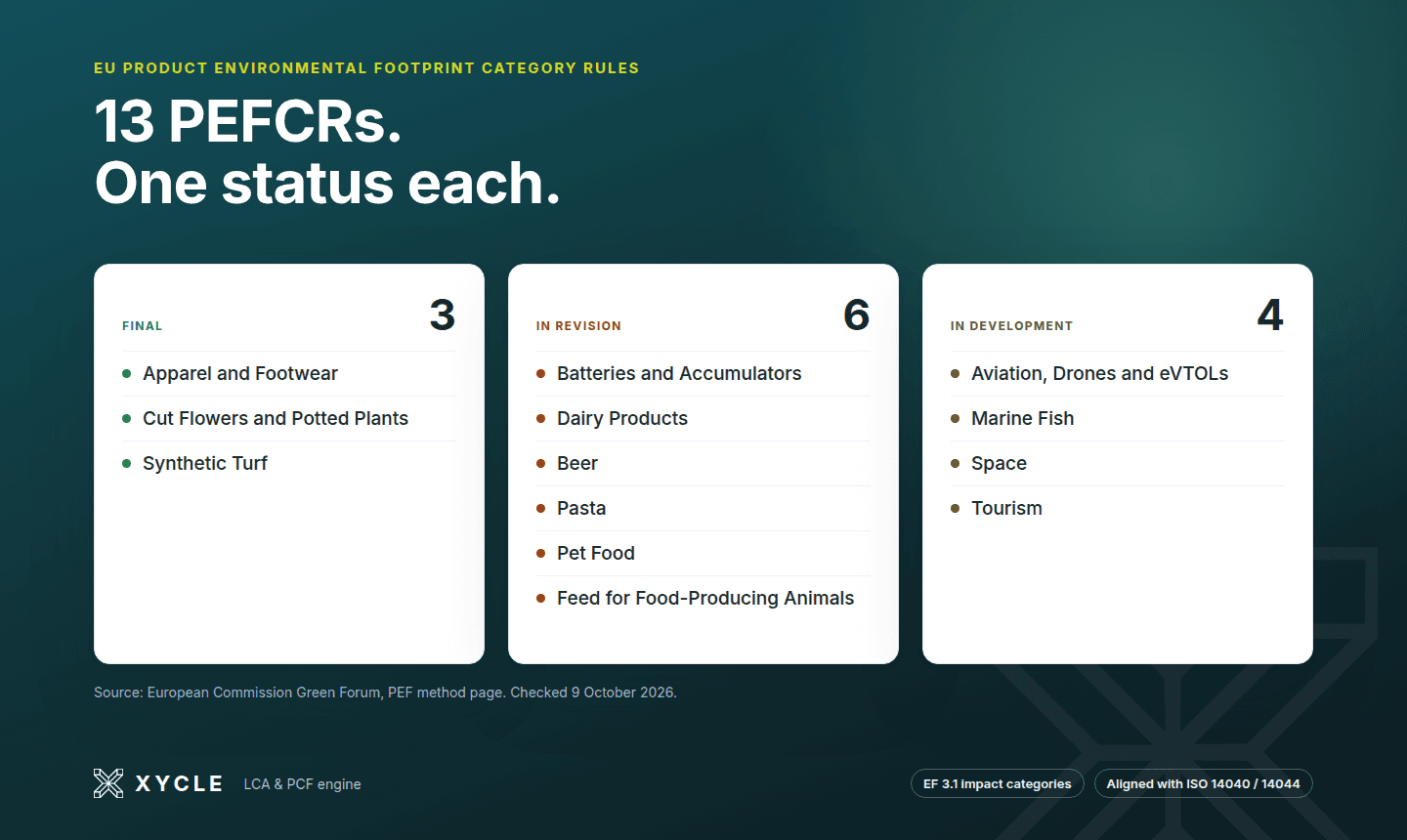
Final PEFCRs

  • Apparel and Footwear

  • Cut Flowers and Potted Plants

  • Synthetic Turf

In development

  • Aviation, Drones and eVTOLs

  • Marine Fish

  • Space

  • Tourism

In revision

  • Batteries and Accumulators

  • Feed for Food-Producing Animals

  • Beer

  • Pasta

  • Pet Food

  • Dairy Products

How do you check which PEFCR applies?

Start with the product, not the label. Match the product to the scope and definitions in the PEFCR, then confirm the current version and status on the Commission’s list. If a PEFCR is in revision, the earlier version may still be the only finished text, so state clearly which version your study follows.

For products outside all 13 categories, a PEF study can still be run using the general PEF method, but without category rules the results are not comparable in the same way.

What do the status labels mean in practice?

  • Final: the rules are approved and can be applied. Check the version number.

  • In revision: an earlier PEFCR exists and an update is under way. Plan for change.

  • In development: no finished rulebook yet. Draft rules and consultations are public, but they can change before release.

For example, the Space PEFCR timeline on the Commission’s site shows a second draft consultation and submission of the final text planned for 2027.

Where to read each PEFCR

This article is the hub for a series covering each PEFCR in turn. Each guide covers scope, status, what changed and what to prepare. They will be linked here as they are published.

A Product Environmental Footprint Category Rule (PEFCR) is a product-specific rulebook for carrying out a Product Environmental Footprint (PEF) study. It sets the system boundary, data quality requirements and calculation rules for one product group, so that two companies measuring the same kind of product follow the same method. The European Commission currently lists 13 PEFCRs as developed or under development: three final, four in development and six in revision.

What is a PEFCR?

PEF is the Commission’s life cycle assessment (LCA) method for measuring a product’s environmental performance. It is set out in Commission Recommendation (EU) 2021/2279 and covers 16 impact categories, not carbon alone. It builds on ISO 14040 and 14044 but removes many of the choices a practitioner would otherwise make.

A PEFCR goes one step further. It applies the general PEF method to a defined product category, drafted and maintained by a Technical Secretariat of industry, experts and other stakeholders. The Commission describes the aim as improving the reproducibility, comparability and verifiability of results for a product group.

Is PEF or a PEFCR mandatory?

PEF is a Recommendation, which makes it voluntary on its own. It becomes relevant when other rules or customers refer to it. The EU Batteries Regulation is the clearest example: the Joint Research Centre’s carbon footprint rules for electric vehicle batteries build on the EF method and on the existing PEFCR for batteries, while introducing some changes of their own.

For product claims, Directive (EU) 2024/825 applies from 27 September 2026 and restricts generic environmental claims and offset-based climate neutrality claims. A PEFCR is not required by that directive, but it is a recognised way to substantiate what a company says about a product.

Which PEFCRs does the Commission list?

The Commission’s Green Forum page lists the PEFCRs developed or still being developed during the transition phase. It states that PEFCRs not on the list are either outdated or private initiatives developed independently of the Commission.

Final PEFCRs

  • Apparel and Footwear

  • Cut Flowers and Potted Plants

  • Synthetic Turf

In development

  • Aviation, Drones and eVTOLs

  • Marine Fish

  • Space

  • Tourism

In revision

  • Batteries and Accumulators

  • Feed for Food-Producing Animals

  • Beer

  • Pasta

  • Pet Food

  • Dairy Products

How do you check which PEFCR applies?

Start with the product, not the label. Match the product to the scope and definitions in the PEFCR, then confirm the current version and status on the Commission’s list. If a PEFCR is in revision, the earlier version may still be the only finished text, so state clearly which version your study follows.

For products outside all 13 categories, a PEF study can still be run using the general PEF method, but without category rules the results are not comparable in the same way.

What do the status labels mean in practice?

  • Final: the rules are approved and can be applied. Check the version number.

  • In revision: an earlier PEFCR exists and an update is under way. Plan for change.

  • In development: no finished rulebook yet. Draft rules and consultations are public, but they can change before release.

For example, the Space PEFCR timeline on the Commission’s site shows a second draft consultation and submission of the final text planned for 2027.

Where to read each PEFCR

This article is the hub for a series covering each PEFCR in turn. Each guide covers scope, status, what changed and what to prepare. They will be linked here as they are published.

A Product Environmental Footprint Category Rule (PEFCR) is a product-specific rulebook for carrying out a Product Environmental Footprint (PEF) study. It sets the system boundary, data quality requirements and calculation rules for one product group, so that two companies measuring the same kind of product follow the same method. The European Commission currently lists 13 PEFCRs as developed or under development: three final, four in development and six in revision.

What is a PEFCR?

PEF is the Commission’s life cycle assessment (LCA) method for measuring a product’s environmental performance. It is set out in Commission Recommendation (EU) 2021/2279 and covers 16 impact categories, not carbon alone. It builds on ISO 14040 and 14044 but removes many of the choices a practitioner would otherwise make.

A PEFCR goes one step further. It applies the general PEF method to a defined product category, drafted and maintained by a Technical Secretariat of industry, experts and other stakeholders. The Commission describes the aim as improving the reproducibility, comparability and verifiability of results for a product group.

Is PEF or a PEFCR mandatory?

PEF is a Recommendation, which makes it voluntary on its own. It becomes relevant when other rules or customers refer to it. The EU Batteries Regulation is the clearest example: the Joint Research Centre’s carbon footprint rules for electric vehicle batteries build on the EF method and on the existing PEFCR for batteries, while introducing some changes of their own.

For product claims, Directive (EU) 2024/825 applies from 27 September 2026 and restricts generic environmental claims and offset-based climate neutrality claims. A PEFCR is not required by that directive, but it is a recognised way to substantiate what a company says about a product.

Which PEFCRs does the Commission list?

The Commission’s Green Forum page lists the PEFCRs developed or still being developed during the transition phase. It states that PEFCRs not on the list are either outdated or private initiatives developed independently of the Commission.

Final PEFCRs

  • Apparel and Footwear

  • Cut Flowers and Potted Plants

  • Synthetic Turf

In development

  • Aviation, Drones and eVTOLs

  • Marine Fish

  • Space

  • Tourism

In revision

  • Batteries and Accumulators

  • Feed for Food-Producing Animals

  • Beer

  • Pasta

  • Pet Food

  • Dairy Products

How do you check which PEFCR applies?

Start with the product, not the label. Match the product to the scope and definitions in the PEFCR, then confirm the current version and status on the Commission’s list. If a PEFCR is in revision, the earlier version may still be the only finished text, so state clearly which version your study follows.

For products outside all 13 categories, a PEF study can still be run using the general PEF method, but without category rules the results are not comparable in the same way.

What do the status labels mean in practice?

  • Final: the rules are approved and can be applied. Check the version number.

  • In revision: an earlier PEFCR exists and an update is under way. Plan for change.

  • In development: no finished rulebook yet. Draft rules and consultations are public, but they can change before release.

For example, the Space PEFCR timeline on the Commission’s site shows a second draft consultation and submission of the final text planned for 2027.

Where to read each PEFCR

This article is the hub for a series covering each PEFCR in turn. Each guide covers scope, status, what changed and what to prepare. They will be linked here as they are published.

Need a product footprint that follows the right rules?

Talk to our LCA team about choosing the right method for your product and preparing for the rules that apply to it.

Talk to our LCA team about choosing the right method for your product and preparing for the rules that apply to it.

FAQ

PEFCR questions, answered

Not finding what you need?

These answers reflect the European Commission’s published PEFCR list as checked on 9 October 2026. PEFCR status changes as Technical Secretariats consult and the Commission approves updates, so confirm the current version before relying on a specific rule.

Rob Pell

Founder and CEO, Minviro

What does PEFCR stand for?

PEFCR stands for Product Environmental Footprint Category Rules. It is a set of product-specific rules for carrying out a Product Environmental Footprint study on one product group, so that results are consistent and comparable within that group.

How many PEFCRs are there?

What is the difference between PEF and a PEFCR?

Is a PEFCR legally mandatory?

Can I use a PEFCR that is still in revision?

How do I find out which PEFCR covers my product?

authors

The team behind your insights

Author

Robert Pell

Robert Pell

Robert Pell

Founder & CEO

Founder & CEO

Robert Pell is the Founder and CEO of Minviro. His doctoral research at the University of Exeter's Camborne School of Mines focused on responsible sourcing of rare earth elements, pioneering novel Life Cycle Assessment approaches and developing methodology for integrating LCA into mine planning. A published scientist and experienced speaker, Robert holds roles as Chair of the Rare Earth Industry Association (REIA) and the Critical Minerals Association (CMA).

Founder & CEO of Minviro. PhD, Camborne School of Mines. Chair of the Rare Earth Industry Association and Critical Minerals Association.

Founder & CEO of Minviro. PhD, Camborne School of Mines. Chair of the Rare Earth Industry Association and Critical Minerals Association.

Founder & CEO of Minviro. PhD, Camborne School of Mines. Chair of the Rare Earth Industry Association and Critical Minerals Association.